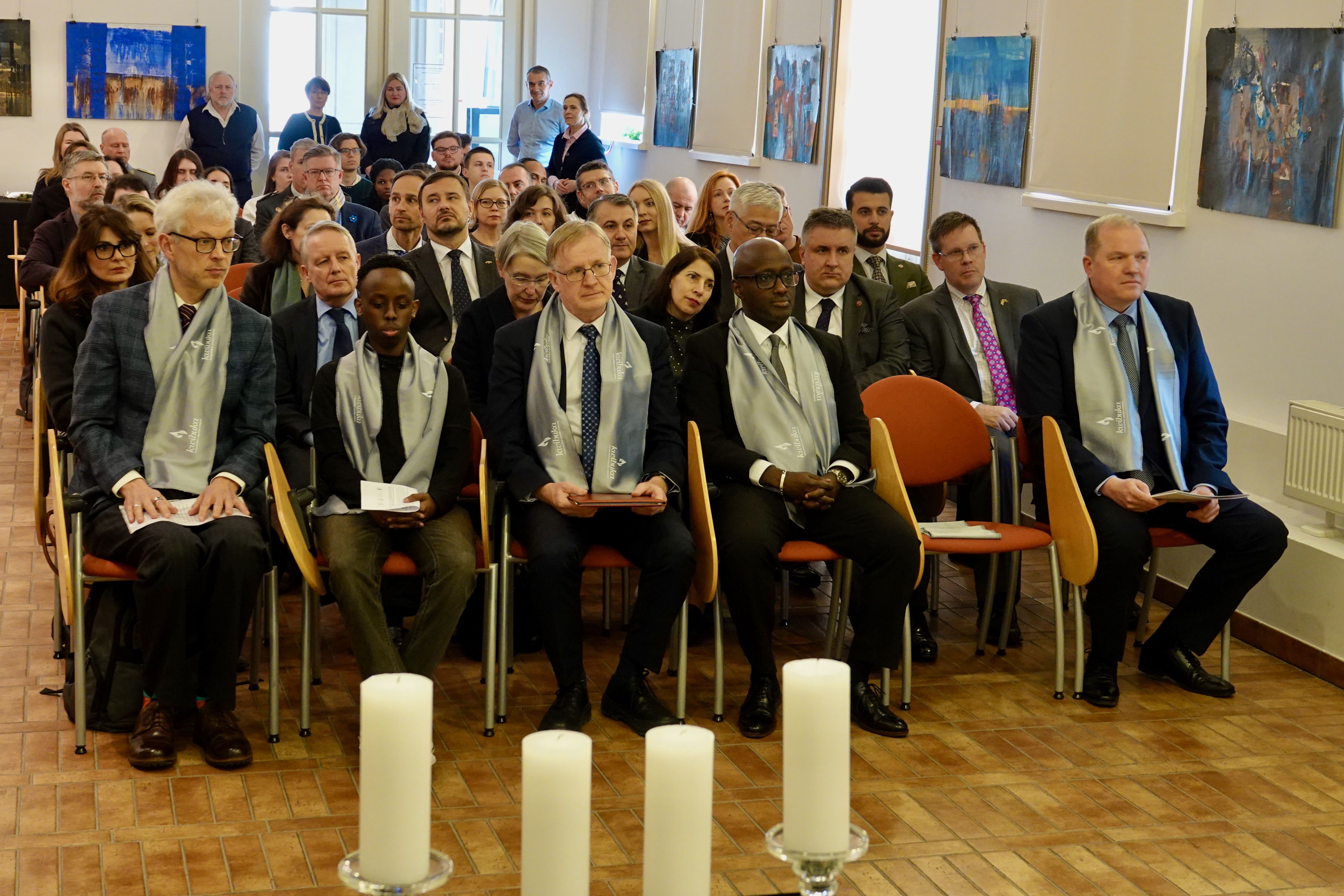
Lithuania marks, for the first time in history, 1994 Genocide against the Tutsi
On the occasion of the 30th commemoration of the victims of the 1994 Genocide against the Tutsi in Rwanda, the Embassy of the Republic of Rwanda to the Republic of Lithuania (with residence in The Hague), in collaboration with the Ministry of Foreign Affairs of Lithuania and the Genocide and Resistance Research Centre of Lithuania, held a commemorative ceremony in Vilnius on the 25th of April 2024.
The commemoration was held at the Memorial Complex of Tuskulėnai Peace Park in Vilnius and was attended by representatives of the Lithuanian government, the diplomatic community and Rwandan nationals living in Lithuania.
The official commemoration ceremony started with lighting of the candles by Dr. Arūnas Bubnys, General Director of the Lithuanian Genocide and Resistance Research Center, Mr. Vytautas Pinkus, Head of the Global Affairs Group of the Ministry of Foreign Affairs, H.E. Olivier J.P. Nduhungirehe, Ambassador of Rwanda to Lithuania (with the residence in The Hague) and Professor Justinas Žilinskas of the University of Vilnius. The lighting of the candles, representing the ever-shining lights of the victims, was followed by a moment of silence.
Program:
-
Lightning of candles followed by moment of silence
-
Welcome remarks of Mr. Arunas Bubnys, General Director of the Lithuanian Genocide and Resistance Research Center
-
Speech of Amb. Vytautas Pinkus, Director of the Global Affairs Group of Lithuanian Ministry of Foreign Affairs,
-
Screening of short video
-
Speech by Mr. Freddy Mutanguha, CEO of the Aegis Trust and Director of the Kigali Genocide Memorial
-
Introduction of genocide as a term in legal law by professor Justinas Žilinskas; University of Vilnius
-
Recorded speech by Professor Robert van Voren, Executive Director of the Andrei Sakharov Research Center for Democratic Development in Lithuania.
-
Speech by Ambassador Olivier Jean Patrick Nduhungirehe, Ambassador of the Republic of Rwanda to Lithuania
-
Poem and music interlude
Ambassador Olivier J.P. Nduhungirehe stated that it’s the very first commemoration in Lithuania and the whole Baltic States of the 1994 genocide perpetrated against the Tutsi in Rwanda.
“Sunday 7th April 2024 was the “International Day of Reflection on the 1994 Genocide against the Tutsi in Rwanda”, as adopted by the United Nations General Assembly in a resolution of December 2003, reaffirmed in April 2020. In Rwanda, the commemoration lasts for the hundred days of the genocide, from 7th April to 3rd July, and the theme of the commemoration is always threefold: “Remember – Unite – Renew”, ambassador Nduhungirehe told the audience in Vilnius today.
“The 1994 genocide against the Tutsi was planned and committed by Rwandans against Rwandans, by an extremist regime against a part of the population. However, this crime was enabled by the failure of the international community, mainly the UN Secretariat, the UN Security Council and individual western powers that were historically and economically linked to Rwanda”, Ambassador Nduhungirehe continued.
“In the aftermath of the genocide, individual powers, through parliamentary commissions, as well as political and academic debates, tried to understand their own failure in Rwanda in 1994. A number of Heads of State and Government of those countries came to Rwanda after the genocide to admit responsibility and present their apologies, in a form or another. The UN, on its part, did the same, and on 15th December 1999, its ‘Report of the independent inquiry into the actions of the United Nations during the 1994 genocide in Rwanda’ concluded that ‘the international community did not prevent the genocide, nor did it stop the killing once the genocide had begun’”, the Ambassador informed.
Ambassador Nduhungirehe said that many genocide memorials were established in Rwanda, including four that were designated last year as UNESCO world heritage sites. “I take this opportunity to thank European and North American countries that erected, on their soil, memorials to honour the victims of the genocide against the Tutsi in Rwanda, namely France, Belgium, the United Kingdom, the United States, Canada, Switzerland, Italy, the Netherlands and Germany. We hope, in order to raise more awareness, to erect more genocide memorials in Europe, especially in the Baltic States”, the ambassador said.
“Beyond memorials, and as requested by the UN General Assembly resolution, we believe that it would be important for Lithuania and for your respective countries, to consider including lessons on the genocide against the Tutsi in Rwanda in your schools’ curricula. Indeed, we have noticed that in many countries in the world and in Europe in particular, young generations don’t know much about this tragedy. We therefore find it important that as the Holocaust is taught in schools, so should be all genocides established by international jurisdictions or recognized by the international community, in particular the 1994 genocide against the Tutsi in Rwanda,” Ambassador Nduhungirehe stated.
H.E. Ambassador Olivier J.P. Nduhungirehe concluded to take the opportunity to thank the Ministry of Foreign Affairs of Lithuania and the Genocide and Resistance Research Centre for organizing this event in cooperation with the Embassy.
For detailed information about Kwibuka visit www.kwibuka.rw
Read / download the speech of Ambassador Olivier J.P. Nduhungirehe.
Read / download the speech of Amb. Vytautas Pinkus.
Read / download the speech of Mr. Arunas Bubnys.
Read / download the speech of professor Justinas Žilinskas.
Watch the speech of Mr. Freddy Mutanguha.
Click here for the photo album of the photos taken during the commemorative ceremony.

Rwanda at the OPCW Executive Council in The Hague
Oath of Rwandan nationality taken at the Embassy

Rwanda takes centre stage at Embassy Festival

Experience Rwanda at the Embassy Festival 2026

Umuganura 2026 celebrated in Groningen
